
Bag frames published by airlines, read on the day we checked
A listed bag is only a cabin bag if it goes into the frame at the gate. These are the frames five European airlines printed on their own pages when we read them, with the dates, and a way to check a listing against any of them.
The frames side by side, in centimetres
We read each airline's own baggage page in a browser on 19 October 2026 and copied the dimensions exactly as printed. Airlines change these rules, sometimes by fare type and sometimes by route, so treat the table as a dated snapshot and check the page linked below it before you fly. Where an airline printed a weight, it is shown; where it said handles and wheels are included, that is shown too.
| Airline | Small bag under the seat | Larger cabin bag | Where we read it |
|---|---|---|---|
| Ryanair | 40 x 30 x 20 cm small bag, under the seat | 55 x 40 x 20 cm, up to 10 kg, with Priority and 2 Cabin Bags | Terms and Conditions of Carriage, articles 8.3.1 and 8.3.2 |
| easyJet | 45 x 36 x 20 cm, handles and wheels included, up to 15 kg | 56 x 45 x 25 cm large cabin bag, booked separately | Cabin bags help page |
| Lufthansa | 40 x 30 x 15 cm personal item | 55 x 40 x 23 cm, up to 8 kg (Economy Light and above on short and medium haul) | Carry-on baggage page |
| Eurowings | 40 x 30 x 25 cm small under-seat bag | 55 x 40 x 23 cm large cabin bag, 8 kg | Hand baggage page |
| TAP Air Portugal | 40 x 30 x 15 cm personal item, 2 kg | 55 x 40 x 25 cm hand baggage, 10 kg | Hand baggage page |
Sources: Ryanair General Terms and Conditions of Carriage, easyJet cabin bags help page, Lufthansa carry-on baggage page, Eurowings hand baggage page, TAP Air Portugal hand baggage page. The IATA passenger baggage rules page describes 56 by 45 by 25 centimetres, wheels and handles included, as a general reference used by many airlines, and notes that weight limits typically start at 5 kg.
What the small bag allowance usually covers
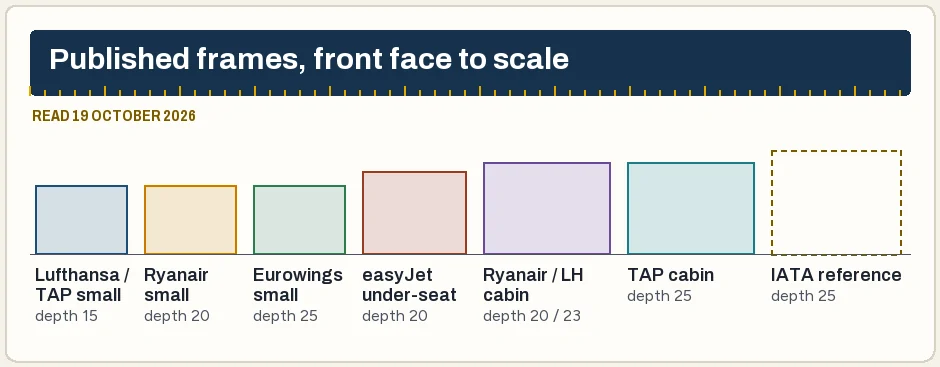
The small bag is the one that goes under the seat in front of you, and on most short-haul fares it is the only bag included. The published frames cluster around 40 by 30 centimetres of front face. The real difference between them is depth: 15 centimetres at Lufthansa and TAP, 20 at Ryanair, 25 at Eurowings, and easyJet's larger 45 by 36 by 20.
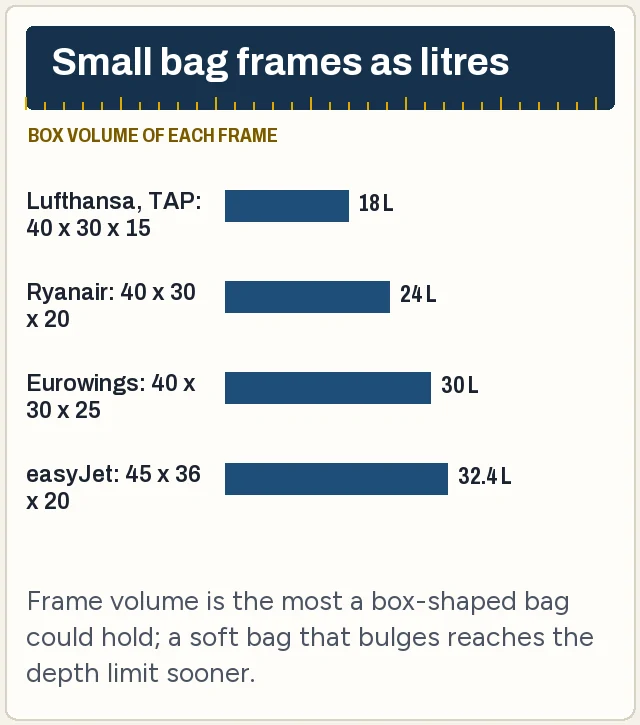
As box volumes those frames work out at about 18 litres for 40 by 30 by 15, 24 litres for 40 by 30 by 20, 30 litres for 40 by 30 by 25 and about 32 litres for easyJet's frame. A backpack sold as 20 litres may fit the deeper frames and miss the 15-centimetre one once it is full, because soft backpacks get deeper as you load them.
Ryanair's terms add a practical detail: its small bag sizers at the gate measure 42 by 20 by 30 centimetres, slightly roomier than the 40 by 30 by 20 written in article 8.3.1. TAP also prints a 2 kg weight for its personal item, which a laptop and a bottle can reach on their own.
Larger cabin bags and the paid tiers around them
The larger bag that goes in the overhead locker is where fares differ most. At Ryanair it comes with Priority and 2 Cabin Bags, at easyJet it is a large cabin bag booked separately, and at Lufthansa it is included from Economy Light upwards on short and medium haul, while Economy Basic includes only the personal item. Eurowings and TAP print 55 by 40 centimetres with depths of 23 and 25.
Weight limits sit beside the sizes: 8 kg at Lufthansa and Eurowings, 10 kg at Ryanair and TAP. A bag that fits the frame empty but weighs 1.5 kg before you put anything in it uses a fifth of an 8 kg allowance on itself, which matters when you choose between two listings of the same size.
Notice that TAP writes its dimensions as height by length by width. The order of the numbers on an airline page is not consistent, which is one reason the Fit box compares sides from longest to shortest rather than by name.
Handles, wheels and bulges count
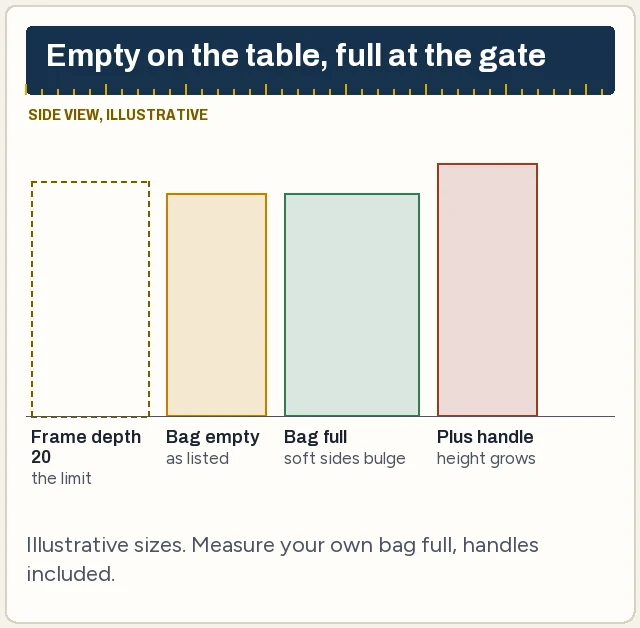
easyJet's page and the IATA reference both say the size includes handles and wheels. For a backpack that usually means the top grab handle and any straps that stick out; for a small wheeled case it means the wheels and the folded trolley handle. A listing's height figure rarely includes the handle, so add it.
The bigger problem is bulge. A soft bag measured empty and flat can gain several centimetres of depth when full, and the gate sizer measures the bag you are carrying, not the one in the product photo. If a listing gives a depth within two or three centimetres of the airline's limit, assume that a full bag will be over it unless the bag has stiff sides.
Expansion zips need the same caution. A bag that meets a 20-centimetre depth with the zip closed may be 25 or more with it open. The Bag shapes page covers how listings describe the expanded size.
Checking a listed bag against a frame
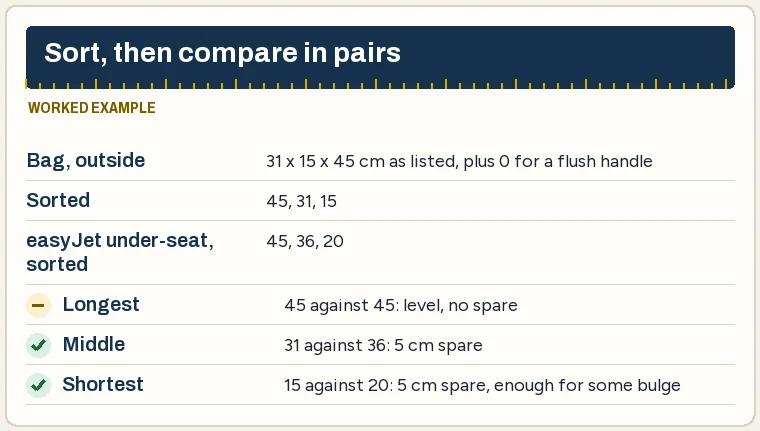
You do not need the airline and the seller to use the same words for each side. Put both sets of numbers in order from longest to shortest and compare them in pairs.
- Take the outside size from the listing. If only one size is given, it is probably the outside.
- Add what the listing leaves out: the top handle, and a few centimetres of depth if the bag is soft and you will pack it full.
- Sort the bag's three numbers and the frame's three numbers from longest to shortest.
- Compare longest with longest, middle with middle, shortest with shortest. Every bag number must be at or under its frame number.
- If one pair is within a centimetre or two, look for stiff sides or a compression strap before relying on it.
The Fit box does steps three and four for you and draws the frame around the bag. It cannot see handles or bulges, so steps one and two are still yours.
These sizes were read on 19 October 2026 and will be read again within 30 days. If an airline's page now says something different, the airline's page is right.
Images: catalogue photographs are category examples, not this site’s purchases or verified Mulebuy orders. Drawn material, dimension and lettering examples explain a concept; they do not certify the depicted product.