
Fit box: try a load in a listed bag before you order it
A listing tells you a bag's size. The Fit box shows what that size holds: ten everyday items packed as boxes, drawn from above and from the front, with the bag's outside checked against one airline frame.
Load the bag and read the result
Type the inside size from a listing, tick the things you want to carry, and choose an airline frame. The two drawings update as you go. The arithmetic stays on your device: no figure you enter is uploaded or saved.
Filling in the Fit box, one group of fields at a time
Here is how to use the tool. The first box takes the inside size in centimetres, across, front to back and height. If the listing gives only the outside, take two or three centimetres off each figure for a soft bag, more for a padded one; the Inside sizes page explains why. If all you have is the seller's litre figure, type it in the litres field instead and the tool will assume a backpack-shaped space, which is a guess and is labelled as one in the result.
Tick the items you want to carry. The tool places the largest first, on the floor of the bag where it can, lying flat before standing up. Each item gets a number in the drawings and a line in the result: fits lying flat, fits standing up, no room left once the others are in, or too big for this bag on its own.
The outside size is only used for the airline check. Leave it empty and the tool adds three centimetres to each inside figure, which is a rough allowance for fabric and padding; type the listing's outside size if it has one.
The working sizes behind each item
Every item in the list has a fixed size, printed beside its name. Paper sizes come from ISO 216; the others are ordinary examples of our own, folded or measured and rounded. They are not measurements of any product in the catalogue, and yours may differ: a chunky hoodie can be twice as thick as ours, and EU 45 trainers are longer than EU 42.
| Item | Size used, cm | Where the figure comes from |
|---|---|---|
| A4 document wallet | 31 x 23 x 1.5 | A4 page (21 x 29.7) plus a wallet edge |
| A5 notebook | 21 x 15 x 1.5 | A5 page (14.8 x 21) plus covers |
| 14-inch laptop | 32 x 22.5 x 1.8 | a typical footprint for the screen size, rounded |
| 1-litre water bottle | 8.5 x 8.5 x 27 | common straight-sided bottle |
| Pair of trainers, EU 42 | 31 x 21 x 12 | two shoes side by side, soles down |
| Folded hoodie | 30 x 25 x 8 | a mid-weight hoodie, folded square |
| Folded T-shirt | 25 x 20 x 2 | folded flat |
| Wash bag | 22 x 12 x 10 | a small zipped toiletry bag |
| Folding umbrella | 25 x 6 x 6 | closed, in its sleeve |
| Cable pouch | 18 x 10 x 5 | chargers and cables in a soft pouch |
What the packing drawings leave out
The tool treats every item and the bag as rigid boxes. Real bags are softer than that, which cuts both ways. Clothes squash into corners the drawing shows as empty, so a bag that the tool calls full may take one more T-shirt. Rounded bag tops, tapered bases and inside pockets take away room the tool counts as usable, so a tight fit in the drawing may be no fit in practice.
It also ignores weight. Airlines print weight limits beside their frames, from 2 kg for TAP's personal item to 15 kg for easyJet's under-seat bag, and the tool cannot weigh anything. Treat its answer as a first pass that tells you which listings are worth a closer look, not as a promise about any particular bag.
Finally, the packing order is fixed: biggest item first, lowest free spot first. A person packing by hand might find an arrangement the tool misses, especially with many small items. If an item is reported as having no room left, try unticking a larger one to see whether the problem is space or order.
The airline frame check, explained
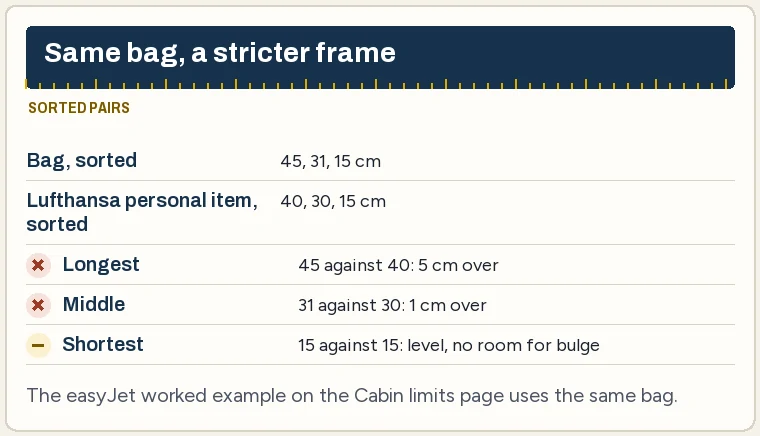
Airlines and sellers name the sides differently. TAP prints height by length by width, Ryanair prints the small bag as 40 by 30 by 20 in its terms and its gate sizers as 42 by 20 by 30, and listings use 长, 宽 and 高. So the check ignores names. It sorts the bag's outside size from longest to shortest, does the same for the frame, and compares the pairs. The bag passes only if every side is at or under its partner, and the result prints how much room is spare or how far over each side is.
The frames in the menu are the ones on the Cabin limits page, read on 19 October 2026. When an airline changes its rule, the tool changes when we next read the page; the airline's own page is always the one to trust.
A pass with no spare centimetres on one side is not a comfortable pass. Gate sizers are rigid and a soft bag bulges, so leave yourself some room on the shortest side in particular.
Images: catalogue photographs are category examples, not this site’s purchases or verified Mulebuy orders. Drawn material, dimension and lettering examples explain a concept; they do not certify the depicted product.