
The inside of a bag, measured apart from its outside
Sellers measure the outside of an empty bag. You pack the inside of a full one. This page is about the distance between the two, and how to read a listing so that the distance does not surprise you.
Where the two sets of numbers part company
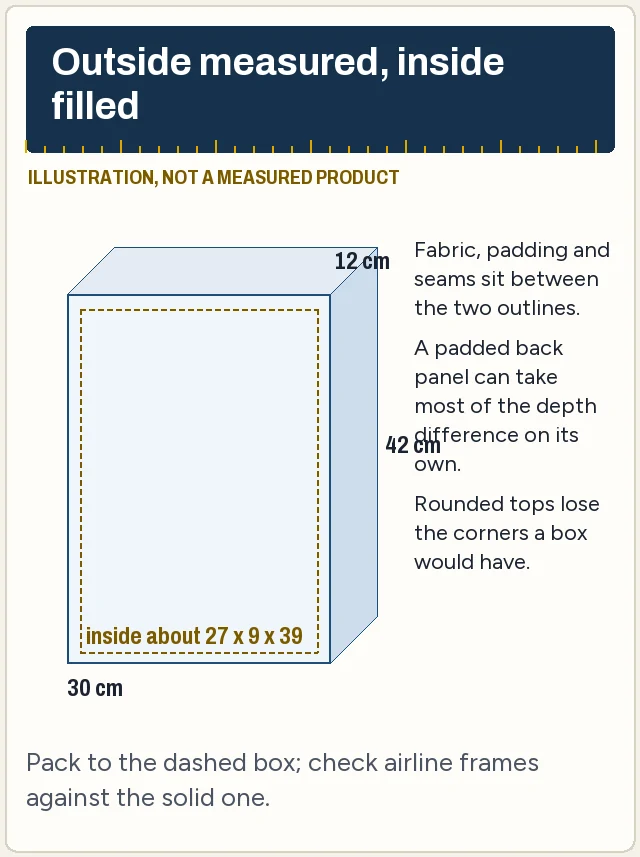
A bag listing usually gives one set of measurements, and in most cases it is the outside: the seller lays the empty bag on a table, runs a tape across the front, along the side and up the back, and writes down what the tape says. The space you can actually fill is smaller in every direction. Fabric has thickness, a padded back panel can take two or three centimetres off the depth on its own, piping along the seams sits outside the usable room, and a rounded top loses its corners.
The drawing next to this paragraph is an illustration, not a bag we measured: an outside of 30 by 12 by 42 centimetres with a dashed inner box a little smaller on each side. The point is the direction of the error. If a listing says the bag is 30 centimetres across, an A4 document wallet of 31 centimetres will not lie flat inside it, however the seller describes the bag's capacity.
Some sellers do write two sets of figures. When you see 外尺寸 (outside size) and 内尺寸 (inside size) together, trust the inside figure for packing and the outside figure for airline frames. When only one set appears, assume it is the outside.
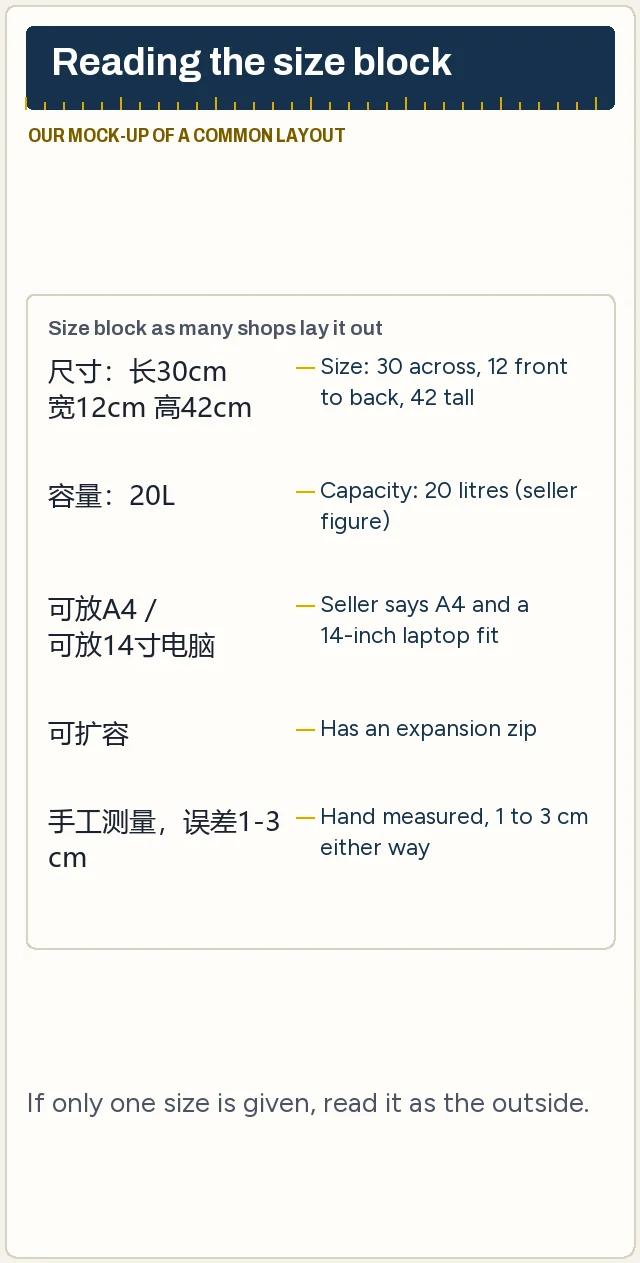
A size line in a Chinese listing, read in centimetres
Chinese listings for bags tend to put the size in a short block near the top of the description or burned into the third or fourth product photo. The words repeat from shop to shop, which makes them easy to read once you know them.
- 长 (length)
- The measurement across the front, left to right. On a backpack this is the width you see when someone wears it.
- 宽 or 厚 (width or thickness)
- Front to back. Listings use either word for what English speakers call depth, and it is the figure most likely to be quoted at the widest point.
- 高 (height)
- Bottom seam to top seam, usually without the carry handle. Some shops add the handle drop separately.
- 容量 (capacity)
- A litre figure, often rounded to a familiar size such as 20 or 30. The next section explains why it rarely matches the box sum.
- 可放A4 / 可放14寸电脑
- The seller's own claim that an A4 page or a 14-inch laptop goes in. Treat it as a hint and check it against the inside size.
Two more phrases matter. 手工测量 means the seller measured by hand, and listings that say so often add that an error of one to three centimetres is normal. 可扩容 means the bag has an expansion zip; the size given is usually the closed size, and the extra depth may or may not be stated.
Litres, and what a seller usually means by them
A litre is a thousand cubic centimetres, so a box 10 centimetres on each side holds exactly one. Multiply the three listed measurements and divide by a thousand and you get the volume of a box that size. For the 30 by 12 by 42 example that is about 15 litres. Many sellers would still call that bag a 20-litre backpack, and they are not always wrong, because the figure on the listing is often a family name for the model rather than a measurement of the sample in the photo.
In practice a stated capacity can include outside pockets, the expansion zip opened fully, or the bag stuffed until the fabric bulges. The box sum, in turn, overstates the room in a bag with rounded corners or a tapered base. The chart below sets four ways of arriving at a litre figure side by side for one illustrative bag, so you can see how far apart honest numbers can sit.
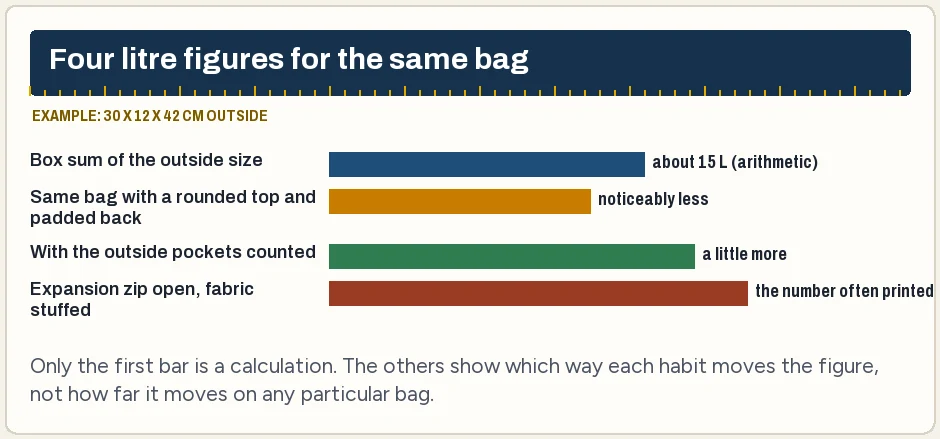
For packing, compare your load with the inside size and ignore the litre figure. For airline frames, use the outside size and the bag as you will carry it, not the empty bag on a table.
A useful habit when browsing the backpack shelf is to work out the box sum yourself and write it next to the seller's litre figure. A wide gap tells you the capacity is a model name, not a measurement.
Depth, the figure that decides most packing
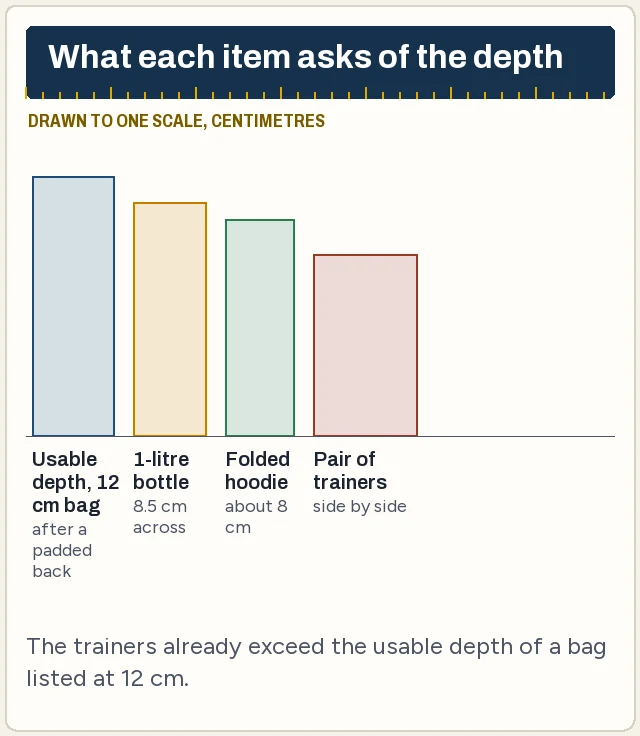
Of the three measurements, depth is the one people misjudge. Height and length tell you whether flat things such as documents and a laptop go in. Depth decides whether anything round or thick goes in beside them: a water bottle about eight and a half centimetres across, a pair of trainers that is ten to twelve centimetres high when the shoes lie side by side, a folded hoodie around eight.
A backpack listed at 12 centimetres deep has perhaps nine or ten of usable depth once the back panel is padded, and that is at the widest point. Many backpacks are deeper at the bottom than at the top, so the bottle that fits at the base will push against the zip if you try to stand it near the opening.
When a listing gives a depth under ten centimetres, think of the bag as a sleeve for flat things plus a small pocket of room. When it gives fifteen or more, rounded items start to sit comfortably, and the bag starts to behave like a box.
Measuring a bag you already own, to compare with a listing
The quickest way to make listing numbers mean something is to measure a bag you already use and like. Measure it the way sellers do, then measure the inside, and you have your own conversion between the two for that kind of bag.
- Empty the bag and lay it flat. Measure across the front, front to back at the widest point, and bottom to top without the handle. These are the figures a listing would print.
- Open it and measure the floor of the main compartment, then the height of the back wall from the floor to the zip line. These are the figures that decide what you can pack.
- Load it with what you normally carry and measure the depth again. A soft bag that grew by four centimetres when full will grow on a flight too.
- Write the three pairs down. Next time a listing gives a size close to your outside figures, you can expect an inside close to yours.
Hand measurements vary. Two people measuring the same bag can disagree by a centimetre or two, which is why many listings print a tolerance.
Images: catalogue photographs are category examples, not this site’s purchases or verified Mulebuy orders. Drawn material, dimension and lettering examples explain a concept; they do not certify the depicted product.