
Everyday objects as a measuring kit for listed bags
Litre figures are hard to picture. An A4 page, a bottle and a folded hoodie are not. These are the objects we measure bags against, with the sizes we assume for each.
Paper sizes from ISO 216
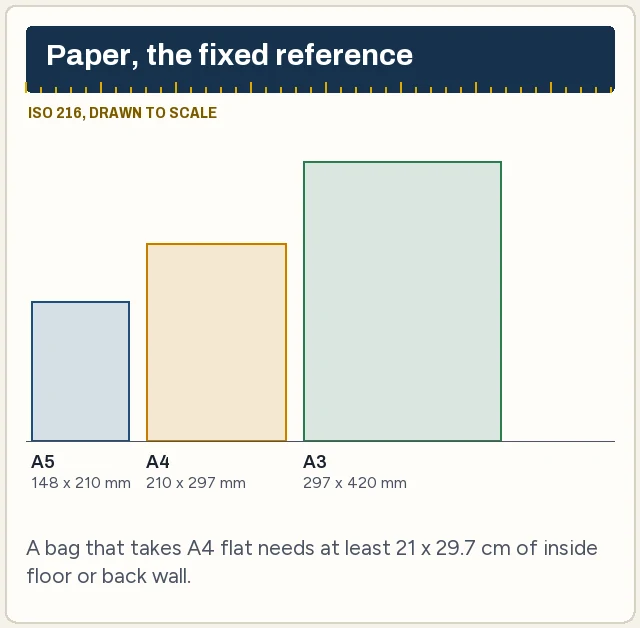
Paper is the most reliable reference load there is, because its sizes are fixed by an international standard, ISO 216. An A4 page is 210 by 297 millimetres. A5 is exactly half of that, 148 by 210, and A3 is double, 297 by 420. Every A size has the same proportions, so folding a page in half across its long side gives you the next size down.
That makes 可放A4 a testable claim. A bag that takes A4 flat needs an inside of at least 21 by 29.7 centimetres in two of its directions. A document wallet or ring binder adds a centimetre or more on each edge, and a hard folder will not bend round a curved top, so a bag that only just takes a loose page will not take a binder.
If a seller shows an A4 page in the product photo, look at where its corners sit. Paper that touches the side seams in a photo of the empty bag will not go in once anything else is packed beside it.
Bottles and the depth they ask for
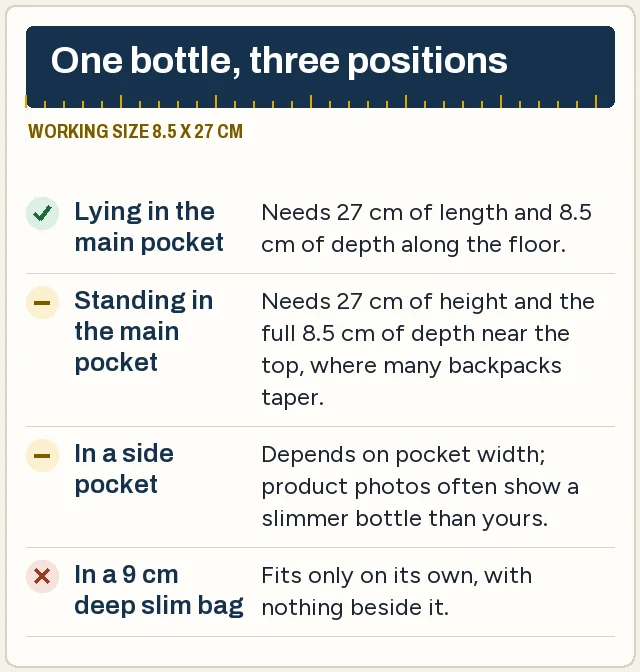
A one-litre water bottle is a good test of depth because it cannot be squashed. The common straight-sided kind is roughly eight to nine centimetres across and twenty-five to twenty-eight tall; we use 8.5 by 27 as our working size. Half-litre bottles are usually around six and a half centimetres across.
Bottles go in one of three places: lying in the main compartment, standing in the main compartment, or in a side pocket. Lying down needs 27 centimetres of length and 8.5 of depth. Standing up needs 27 of height, which most backpacks have, but it also takes a full 8.5 of depth at the top of the bag, where backpacks are often thinnest.
Side pockets in listings are described with phrases such as 侧袋可放水杯 (side pocket takes a cup or bottle). The photo usually shows a slim bottle. If yours is a wide insulated one, look for a stated pocket width or a photo with a ruler.
Folded clothes, a pair of trainers and a wash bag
Clothes are the load most people pack, and they are the hardest to pin down because they compress. The sizes below are the working sizes we use in the Fit box. They come from folding ordinary items of our own into a neat rectangle, rounded to whole centimetres; your hoodie may be thicker, your trainers bigger. What matters is having a fixed set to compare bags against.
Notice how different the shapes are. A T-shirt folded flat is barely two centimetres thick but needs a 25 by 20 floor. A pair of trainers is compact in length and width but needs 12 centimetres of height or depth, whichever way you turn it. A wash bag is the awkward middle: not long, not flat, not squashable.
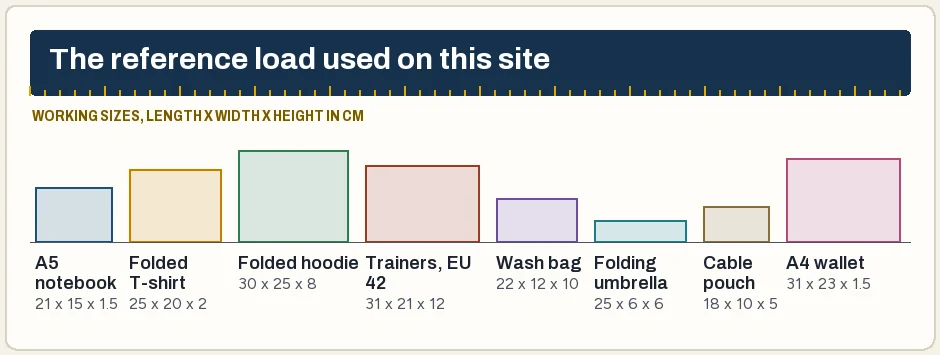
If you are buying a bag for a particular trip, put the clothes you would take on the floor in neat folds and measure the pile. That one rectangle is a better reference than any litre figure.
Why the sum of volumes overstates what fits
It is tempting to add up the volume of everything you want to carry and compare it with the bag's litres. The sum alone can overstate usable packing space. Rigid items leave gaps around them that soft items only partly fill, round things waste the corners of a square bag, and the top few centimetres under a zip are rarely usable once the zip has to close.
Our reference load of a hoodie, a T-shirt, a wash bag, an A5 notebook and a cable pouch adds up to roughly eight and a half litres of item volume. In practice it needs a bag with considerably more room than that, because the wash bag and the hoodie cannot share their corners. The Fit box shows this directly: it places items as rectangles, so you can see the empty spaces between them.
A rough working habit is to treat the litre figure as an upper bound and plan on filling noticeably less of it with mixed items. Soft clothes alone pack tighter; boxes and bottles pack looser.
Choosing your own reference load before reading a listing
Before you open a bag listing, decide what the bag is for and what it must carry on its fullest day. Three to five items are enough. Measure them, or use the working sizes above if they are close, and write down the smallest box that holds them side by side.
Then read listings against that box. A bag whose inside matches your box in all three directions will carry your load. A bag that matches in two directions but falls short in the third will carry it only if the short direction is the one soft clothes can absorb.
- For a commuting bag, the usual fixed items are a laptop or document wallet, a bottle and a lunch box.
- For a cabin bag, start from the airline frame on the Cabin limits page and work inwards.
- For a gym or overnight bag, the shoes decide the shape more than the clothes do.
Images: catalogue photographs are category examples, not this site’s purchases or verified Mulebuy orders. Drawn material, dimension and lettering examples explain a concept; they do not certify the depicted product.